The philosopher and novelist Albert Camus notably remarked in his book The Myth of Sisyphus that “there is but one truly serious philosophical problem and that is suicide.” As Camus saw it, whether or not life is worth living is the fundamental question that philosophy must strive to answer.
He also said, “If you want to be a philosopher, write novels.”
Perhaps, some philosophers prefer to write music instead.
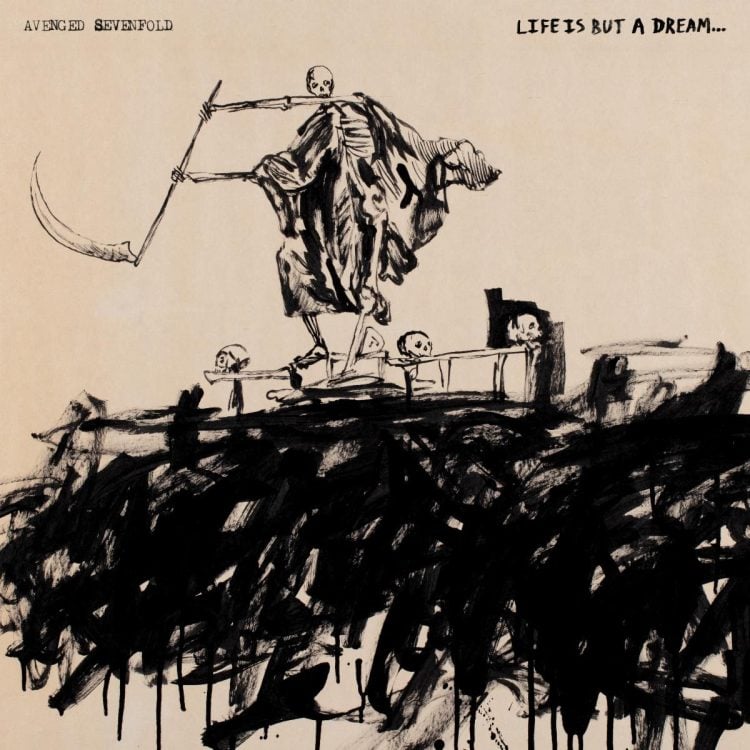
Last week, the band Avenged Sevenfold released their first album in seven years, titled, Life is But a Dream…, which is inspired by Albert Camus’s writings on absurdism and existentialism.
As the band summarized their album, it is “a journey through an existential crisis; a very personal exploration into the meaning, purpose and value of human existence with the anxiety of death always looming.”
With this album, Avenged has continued to break free of their typical approaches to writing music, and has ventured deeper into their philosophical and educational route. As the band expected, reactions to the album have been perfectly polarizing, with certain listeners lauding their progressive approach, while certain others pining for the “old” Avenged Sevenfold.
But no matter what your opinions may be, there’s no denying the fact it is unlike any other album in their discography, or anywhere, period.
Into the Absurd
Albert Camus’s novel The Stranger tells the story of a character named Meursault, who contends that there is no meaning to life, and that it would therefore be absurd to look for meaning.
As the story goes, Meursault pulls out his gun and shoots another man at a beach after a long argument. Nonchalantly, he walks over to the man’s body and shoots another four times. When he is arrested, he couldn’t give a palpable reason to his crime, only that the sunlight and the heat were getting on his nerves. And later, as he awaits his death sentence, he feels no remorse or guilt, as he lays “my heart open to the benign indifference of the universe.”
This subject of absurdism has been iconic in literature, as it concerns the darker part of ourselves that struggles to find meaning in life’s apparent randomness. And of course, it would also find its place in Avenged Sevenfold’s Life is But a Dream….
For the members of Avenged, the allure of this subject was too compelling. Mostly in their 40s, the members are all married with children, and to add to that, they have together faced head-to-head with mortality, after the devastating sudden death of their drummer and longtime friend, Jimmy. Consequently, this rhythm-change has massively impacted how they view the world, and how they write their music.
Their 2016 album The Stage was the first to embody their newfound maturity. To some extent, the album is existential in nature, as it involves questioning the nature of reality. The album discusses society’s current and future concerns, such as artificial intelligence and nuclear war. And as a solution to these mostly egotistical concerns, the album suggests that its listeners embrace a cosmic perspective (you can read my analysis here).
Despite the fan backlash due to their new direction, The Stage ended up being their fifth album in a row that was certified platinum.
After The Stage, though, the members of Avenged Sevenfold plunged deeper into an existential crisis, where they found themselves reflecting on their place in the world, the purpose and value of life, and the priorities that truly matter to them.
Especially for singer and songwriter Matt, this crisis led him to studying Albert Camus’s writings such as The Stranger, as well as experimenting with the intense psychedelic drug 5-MeO-DMT. Initially, his crisis only worsened over the next six months.
“It was the worst thing in my life but I’m so grateful for it now,” he said. “I couldn’t go anywhere, go to the gym, eat meat or drink alcohol. I couldn’t do anything. I was so locked in (my own head). I’d just walk the streets and contemplate suicide.”
Eventually, just as Camus suggests in his writings, Matt realized that perhaps life has no objective meaning, and that he was free to create and live by his own meaning. As Matt explained, “One day, I realized: this is freedom! There is no meaning. I can do whatever I want. Suddenly, it just clicked.”
Just as they did with The Stage, the band understood that they had to fight hard to venture out of their comfort zone in order to make the album that best captures the existential crisis that they experienced. “We were just looking for really bold moments — in life, in art, in film,” said Matt. “Things that we could sort of wrap our minds around an audio representation of how we were feeling about certain things.”
In approaching the writing process, the band deliberately cut down on their typical traits and formulae, and instead doubled down on the things that they would normally skimp out on.
Musically, what resulted out of that process is a strange Brompton cocktail of their genre-spanning influences, such as Kanye West, Travis Scott, Daft Punk, and Frank Sinatra. As if mirroring the nature of life itself, the progression between the songs can feel unpredictable and absurd at first listen, only to make more and more sense given the time and space for reflection.
Lyrically, as it promises, the album delivers on its message on what it means to be alive, and how we can relate with death. And just as importantly, the lyrics sync in beautifully with the music.
As Matt remarked on the writing, “It’s very lyric-driven because it really is this existential crisis with this sort of thing we all deal with, which is death looming. It goes into a lot of mindfulness, a lot of almost Buddhist teachings where, when death is always looming, there’s two ways to go about it. If you find life is meaningless, then what purpose are you going to attach to your life to make it somewhat bearable?
“But to talk about that, you need the music to have tension, and you need the music to almost feel uncomfortable…The things we’re talking about are uneasy, and they don’t feel pleasurable or release-driven — until we want you to get there.”
The album is truly a visceral experience, and it is evident in the songs that the subject matter at hand is very personal to the band. Speaking as a father, lead guitarist Brian said, “The Stage was an incredible feat, but this one gets more heartfelt and introspective, and delves more into existentialism. Whether people know the word or not, we’re all experiencing it. You get to a certain point and you’re like, ‘I know we all die…wait…we all die?!’ And then you have kids and you’re like, ‘They’re gonna die one day.’ And it fucking hits you like a sack of shit.”
Some of the most notable songs on the album include its open track Game Over, which portrays the brief passing of life. The song’s transitioning from a slow acoustic intro into a frantic barrage of “life moments” such as learning to walk, going on your first date and getting married is reflective of how we are immediately thrown into a world of anxiety and chaos upon our birth.
“We’ve all been through all those things, and it shows how quickly it happens and how the only real answer is being present in all the moments, or it’ll just pass you by,” Matt commented. “It’s like you blink one day and you’re 80 years old on your deathbed, and you go, ‘Well, how the fuck did that happen? Did I do any of the things I wanted?’”
Mattel, which is named after the major toy company, is inspired by a time when Matt was strolling in his neighborhood and noticed that nearly all of his neighbors’ houses had fake grass. He felt that the houses looked too perfect, and the people were “Truman-Show-like”. The song therefore ruminates on society’s plasticity, and how daily modern life has become a performance.
We Love You questions society’s capitalistic definition of success that is drummed to us at an early age, which is to have more, and more, and more.
Nobody is perhaps the most representative of Albert Camus’s ideas, as the narrator in the song comes to realization that in the grand scheme of things, he is nothing. Devoid of his ego and self-importance, he ceases to derive meaning from a meaningless world. And in that, he embraces the absurdity of life.
The trio of G, (O)rdinary, and (D)eath tells an interesting narrative of a creator who makes a robot that has its own intelligence. Trapped within the confines of its own mechanical body, the robot yearns to be free and to experience life as human beings do. Eventually it accepts the wild journey that its life is, as it comes to an end.
It’s also refreshing to notice that, in spite of the serious subject matter, the band still manages to inject some humor and fun into these songs. For instance, in Game Over, the band uses the word “bestest” like in an old Folgers coffee commercial. And in (O)rdinary, the lyrics go “I wanna be the human you be” — kind of like how a ChatGPT AI comes up with brilliant sentences, and suddenly fumble at a few words.
These moments are what give the album such a life-like quality, because life can be serious and tragic at times, but other times it can also be hilarious and comical.
Finally, the title track, Life is But a Dream… is a fitting finish to the album. The song is an all-piano track played by lead guitarist Brian, which he originally composed for the birth of Matt’s first child about a decade ago. Within the weighty context of the album, it sounds beautifully haunting. Perhaps Matt described it best, in that it made him imagine the scene in The Shining where “Jack Nicholson’s at the bar and he’s talking to the people that had been there before him and they’re all dead.” It makes you think back on the album in its totality, in all its craziness, like it was all just a delirious dream.
And that brings us to the fundamental question here, and that is, what does the band really mean with the title Life is But a Dream…? And why the three periods?
“I started playing with the idea of ‘which is the dream, which is real and does it really matter’?” said Matt. “You come into this world, you learn how we do things here, you learn what success is here. But it really holds no weight outside of this human construct, this society and tribe we’ve built. And then one day you turn off.”
Ultimately, Matt left the question for us to answer for ourselves.
He added, “We all have these ways we cope with this place and these answers we tried to find. It doesn’t really matter what you think and believe as long as you can, at least for yourself, find some sort of meaning or purpose…So these little three dots mean whatever you want them to mean.”
As they put out this radically progressive album, the band believes that they would have made their late friend Jimmy proud. “He’d be stoked,” said Matt. “(We) know that guy better than anyone. He was always the biggest proponent of instigation and trying new things.”
Thoughts on “Life is But a Dream…”
The first band I ever saw live in concert was Avenged Sevenfold back in 2012, so quite naturally, I have a particular soft spot and attachment to their music.
Even as a big fan, I could personally recall what it was like in 2016 when The Stage was released. Nearly all of my friends who loved the band hated the album. And everywhere, it felt as though the fanfare for the band had massively died down.
I too wondered what the hell they were doing. I listened to the album expecting to find what the band was best known for, which was their catchy hooks (which I still see nothing wrong with). But as far as I listened, there was very little of that. I paid little attention to the lyrics and other aspects of the songwriting, and halfway through the album, I gave up on it.
It was not until Covid hit 4 years later that I finally gave the album another chance and listened to it in its entirety. Because like so many people at the time, I was desperately looking for a reason to stay alive. Since then, I had a newfound appreciation for the band’s philosophy. The Stage helped me relate to the world in a way that I never had before. It forced me to see far beyond my own self-importance, and to reconsider how small my place really is in our ever-expanding universe. I eagerly waited for their next album.
I waited on the dot at midnight for the release of Life is But a Dream… last week. And after my first couple of plays, I was speechless — but not in a good way. I was confused. I was weirded out by the Kanye West and Daft Punk influences. At times the album sounded like an Avenged version of a Disney soundtrack. Maybe I expected more of The Stage in this album. I thought The Stage was weird, but this was even weirder.
But whenever I wasn’t listening to the album, I found myself thinking about it more and more. Surely it grew on me. And the aspects of it that I initially found repulsive no longer seemed so crazy or out of place — they even started to make sense. I started playing the album on repeat and I fell in love with it.
And that brings me to my point here — for us as human beings, change — even good change — is always uncomfortable. We like to think that we like things that are different and new. But when something different and new arrives at our doorstep, we often end up hating it because it’s unlike anything we’re used to. We crave the familiar. And we have nothing familiar to compare it with. But with time, and with challenging ourselves, it can grow on us.
In one of his recent interviews, Matt, who expected a giant wave of backlash for this album, gave an analogy of an iPhone. So often when a new iPhone is released, we hate the new features because we’re not used to them. But over time we couldn’t imagine ourselves living without them.
If you approach the album with whatever previous definition that you might have had of Avenged Sevenfold, you’re going to be disappointed. Instead, you just have to let go of your preconceptions and open yourself up to the album, and listen to it as it is.
I definitely started enjoying the album a lot more once I acknowledged that they’re no longer the same band that I saw live 11 years ago. They’re no longer the same band that wrote City of Evil, or Nightmare, or The Stage, for that matter. And that’s not a bad thing. After all, if you want to listen to the old stuff, they’re always going to be there — that’s why they were recorded.
A common phenomenon that I’ve observed among well-established bands — especially the more veteran ones — is that they don’t get older. Instead of writing music that is reflective of their present station, they attempt to recapture a time from when they were in their “prime”. You can see that with Metallica, whereby their past two albums were largely attempts to rehash their classics. They were just playing a low-risk-low-reward game.
And that makes me respect Avenged Sevenfold all the more. They courageously made the decision to never settle someplace and think that they’ve made it. To them, they don’t have a prime era. Even though they’re in their 40s, they’re still taking bold risks like they did when they were in their teens, when they first jumped into a beat-up touring van, not even knowing if the band would survive.
They’re risking alienating their fans. They’re risking losing mainstream and commercial appeal. But they’ve become much better artists in the process.
As rhythm guitarist Zacky remarked, “We gotta be willing to lose everything that we’ve built in the last 20-something years, we have to be willing to risk all of it for the excitement that brought us to do this in the first place…Take the risk at 40 years old. Write the album that you want to do, put the art out the way you want to do it. Be willing to lose your house. Be willing to start over to do something you love. And if you’re not willing to do that, you’re not going to be able to create something that’s true to yourself and true in your heart. You’re just running through the motions.”
Fearlessly, they’ve emphasized their own growth as artists over any worries of success or failure. They wrote and played from the heart, and that is enough for them to believe that their art will find its way into its audience.
“Just say your message and put the art out there,” said Matt. “Artists should do what they want and explore deeper rabbit-holes.”
“Just put it out there so it exists, and people will find it.”
 Izzat Zailan
Leave a Comment