

The 50th Law by Robert Greene and 50 Cent

I’m on a plan to re-read every book written by Robert Greene, who is one of my all-time favorite authors. I kicked it off with The 50th Law, because it was the first Robert Greene book that really spoke to me when I was 16. I guess I was at a turning point in my life where I started to realize how Greene’s ideas made sense. Just a year before that, I was turned off by the few pages I read in The 48 Laws of Power, which I naively thought was an evil book.
The 50th Law is actually Greene’s most atypical book, and perhaps his most underrated. Unlike his other books that are dense and long, The 50th Law is a relatively easier and shorter read. Not only that, it was co-written by rapper 50 Cent, as it takes inspiration from his rise from a street hustler to a world-renowned musician. Interweaving 50 Cent’s story with that of great historical figures, this book offers practical strategies on how to be fearless, or to fear less.
If you’ve never read Greene’s books, this would actually be a good place to start (though the Concise editions of his longer books are great as well). In terms of style, this book may be the odd one in Greene’s portfolio, but it doesn’t at all compromise on his articulacy and practicality.
Re-reading this, it’s interesting to see how the seeds for some of his other books are planted in this one. For example, there’s a chapter on Mastery which is expanded on in his succeeding book Mastery, and there’s another chapter on The Sublime, which is the focus in his upcoming book The Law of the Sublime.
The Tartar Steppe by Dino Buzzati

I knew about this amazing book from reading Nassim Taleb’s The Black Swan last month. This story is about a young soldier who is stationed at an old and remote fort, as he hopes to die honorably in a battle that may or may not come. Meanwhile, a lifetime of opportunities in the outside world passes him by. Yet he holds on to his hope, leaving behind his cherished friendships, and his chance at starting a family. Eventually, the battle does happen, but being already too sick and frail, he is instead sent home, where he dies alone.
In hindsight, it’s a simple story, but such a poignant reminder on why we shouldn’t tether our sense of meaning and happiness on things that aren’t in our control. Because the opportunity costs are just too high — we can never get back the time we spend simply hoping for our situation to change. An arguably better way to live happy and meaningfully is to find happiness and meaning in the things we do, and how we live, rather than what we may or may not get.
The Myth of Sisyphus by Albert Camus

This was my first time doing homework prior to the release of an album. In this case, it was Avenged Sevenfold’s Life is But a Dream… which is inspired by Albert Camus’s writings. Camus basically argues that there is no inherent meaning to life, that the struggle in doing so is pointless. He compares this struggle to that of Sisyphus in Greek mythology, who is punished into rolling a rock to the peak of a mountain, only to have the rock roll back down to where he started every time he succeeds.
But personally, do I believe that there is no meaning to life? From a religious perspective, I don’t. Because simply, as Muslims, we are taught that the ultimate point of life is to serve God. But I do understand the struggle in feeling that life is meaningless, and I believe everyone undergoes this struggle at some point in their lives. And perhaps, from a more social perspective, I believe that life’s meaning is subjective to ourselves. Not everyone finds the same extent of meaning in society’s standard metrics for a good life, like having a lot of money. In this sense, the meaning of life is what you make of it.
King Lear by William Shakespeare
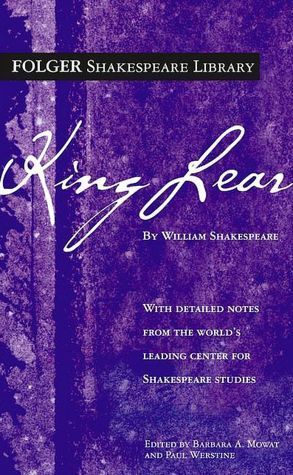
“The hedge-sparrow fed the cuckoo so long, that it’s had it head bit off by it young,” as Shakespeare writes in King Lear. As with many of Shakespeare’s plays, King Lear is largely a family tragedy. This play follows an aging king in his dilemma in dividing his kingdom to his three daughters. Tragically, his decision-making is blinded by his yearning for his children’s love and respect, that he only realizes too late that two of his children are only interested in his power. Now a dethroned king without a kingdom, he descends into insanity, while his family falls apart from their own pointless squabbles.
I couldn’t survive Shakespeare’s writing without a good guide. But despite how difficult and archaic his language is to me, it’s always amazing to think about how timelessly relevant his plays are. Among many other things, the play shows us that power — or the lure of it — reveals who people truly are. As the story goes, King Lear asks his daughters to proclaim their love for him, in order to decide how he would divide his kingdom. While two of his daughters engage in this contest, his best-mannered daughter, Cordelia refuses to do so. She sees through her sisters’ BS, and authentically tells King Lear that she loves him too much for that trivial display of affection. Logically, Cordelia is easily Lear’s best choice. But in his ego, Lear disowns Cordelia, and her ingrate sisters get their share of his kingdom.
The Good Son by Paul McVeigh
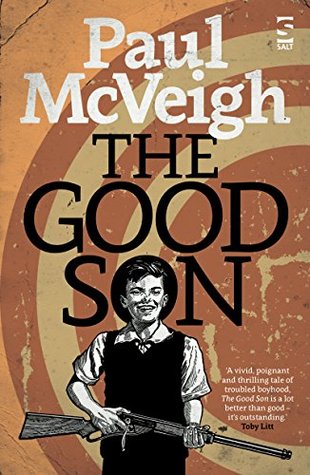
This was one of the most refreshing novels I’ve read in a while. Inspired by the author’s own childhood, The Good Son is a coming-of-age story narrated by a mild-mannered young boy growing up in Northern Ireland during The Troubles. The narrator dreams of getting out of Ireland someday, bringing along his mom and his little sister with him, and leaving his abusive father behind. But as he comes to terms with how the world works in reality, he learns the hard way that sometimes, he has to be a little cunning to be the good son that he wishes to be.
As this book is written in Irish dialect, it was nice to learn a slang or two. “Wee” is relatively straightforward, meaning “little” or “young”. But I never would’ve thought that “lumber” meant “making out”. And of course, it was very interesting to learn a little about Irish history, particularly The Troubles, which I had never heard about prior to reading this book. I also love the gallows humor style of this book. It reminded me of some of my favorite Kurt Vonnegut books, like Slaughterhouse Five and Cat’s Cradle in that if done well, humor can be a great tool to get the reader to really think and relate about important social matters. And unsurprisingly, Paul McVeigh coming from a comic background himself, does this masterfully in The Good Son.
 Izzat Zailan
Leave a Comment