“Nothing is at last sacred but the integrity of your own mind.”
Ralph Waldo Emerson,
Self-Reliance
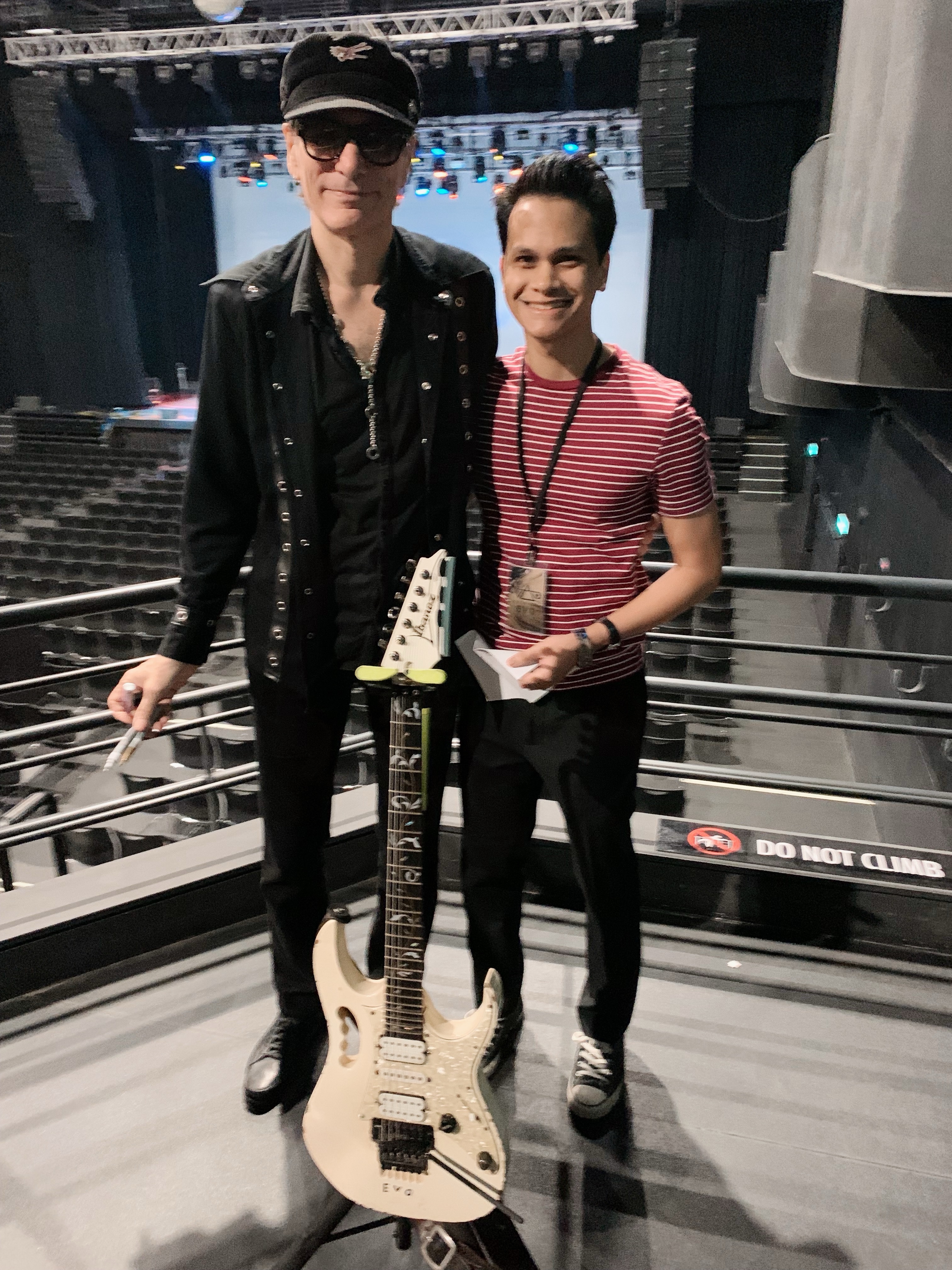
Earlier this week, I got to meet one of my guitar heroes, Steve Vai. You may have read some of my writings that featured him, including last week’s article, Discipline Equals Freedom, and Letting Go of the Known from a few months back.
Steve is easily one of the most unique and distinct living guitarists out there. “Legendary” is truly a fitting word to describe his mastery of the guitar. But it’s not just the music that I love so much, but also poring through his interviews in which he has talked about creativity and spirituality — and the interconnection between these two. So, I decided to participate in his pre-show program.
People say that you shouldn’t meet your heroes, because you’d only end up disappointed. But it certainly wasn’t the case for me in meeting Steve. If anything, it made me wish that more artists were as humble and generous as he is in sharing their knowledge with the world. The program started with a QnA session, and I got to sit literally across him.
When I raised my hand to ask my question, I suddenly blanked and I forgot what I was trying to say for a few seconds. As soon as I remembered, I asked him, “Obviously you have plenty of experiences under your belt. How do you think your creative process has changed since the time you started writing music, until now?”
“Hmm,” he thought for a moment. “It hasn’t changed at all.”
“I’m inspired by the same thing as you are, and that is, a good idea,” he said. He explained that his creative process essentially consists of recording small snippets of ideas, which he would shelve and gradually weave together and refine over time.
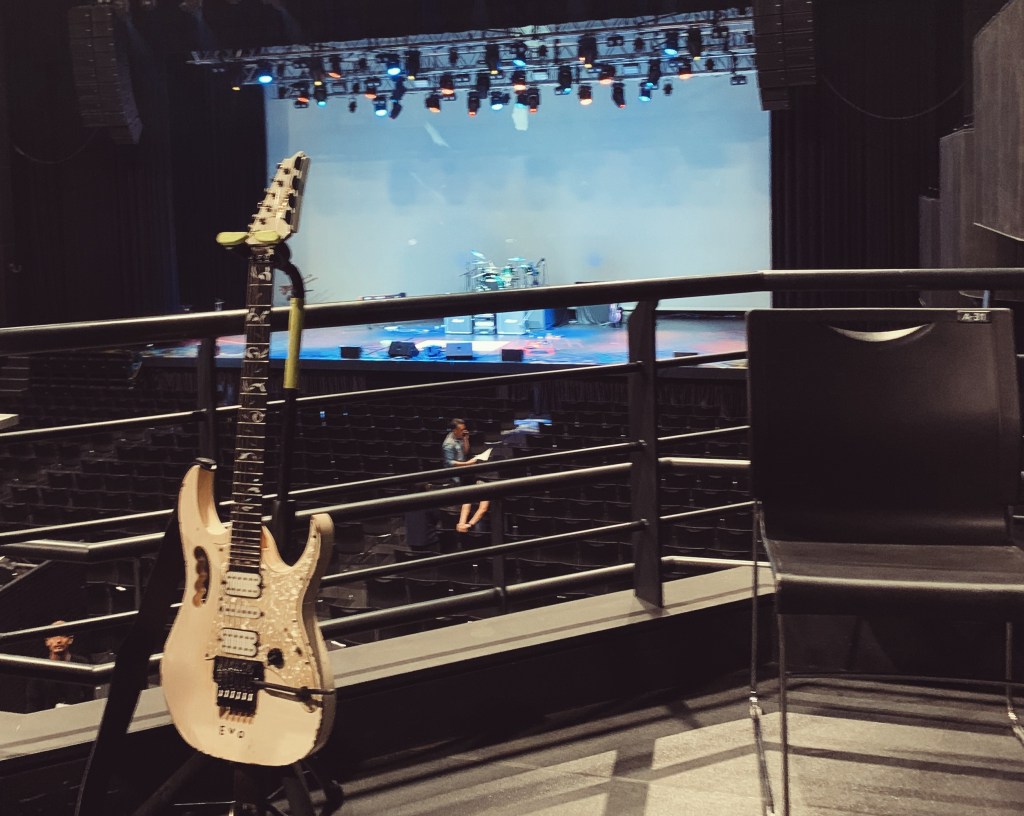
Demonstrating this process, he picked up his iconic “EVO” guitar, which stood unplugged beside him. He played the chords to his most well-known song, For the Love of God, while he sang the main melody of the lead guitar. According to Steve, this tiny snippet came about when he was 13 years old and was just noodling on his guitar. It wasn’t until many years later that he had a complete song worked out. He also demonstrated a similar process for another song called Little Pretty, as well as for the creation of his new three-necked guitar, the “Hydra”.
Steve would typically undergo this process by stealing a few minutes before bedtime to noodle on an unplugged guitar and record his ideas. He joked that on many of his recordings, his wife could be heard readying herself in the bathroom, and occasionally saying, “That’s a good one!”
But here is also where the challenge is. Steve explained that during this process, we may come across many ideas that are unique to ourselves. Yet, out of overthinking, many of us reject these ideas because we’re concerned with what other people may say, and their definitions of good and bad. So, we take the easier way out, which is to imitate what has already been done before.
For Steve, he learned to overcome his inner critic by holding on to the simple rule that if an idea excites him, then that’s all that matters. An idea has to move only him, and no one else. He explained that it’s common for himself to be moved to tears when he is working on his songs.
Among many other generous examples that Steve explained to me, there was one in particular that I would keep close to heart. He asked if I was a guitar player, and when I said yes, he called me to stand and be closer to him.
“I’m going to play a few chords, and I want you to come up with a melody,” he said. Of course, I was extremely nervous standing in front of everybody, and I just sang the dumbest melodies that I could think of in that moment.
“You’re thinking too much,” he told me. “I know you’re thinking, ‘I’m standing in front of Steve Vai!’ But that’s okay. We have the melodies. So, we just need to figure out how to connect them.”
After I got back to my seat, he said to me, “This is my assignment to you. I want you to practice what we just did. When you get back home, pick up your guitar and just play the first thing that comes to your mind. Don’t think about whether it’s good or bad. Never underestimate the worth of your own ideas.”
Looking back at this event, I find it incredibly endearing and inspirational. Events like this are important, because they remind you that the artists you look up to are human beings as well. They aren’t exempt from having the same struggles or insecurities as you do in creating art.
I found it interesting that his creative process isn’t so different from mine in my writing. Since I started writing, my process hasn’t changed either in that I would scribble ideas and thoughts on my notebook. It’s not unusual for it to sometimes take months or even years for the dots to connect, or for these ideas to build up into an article.
Steve’s lesson for me that day also reminded me of Ralph Waldo Emerson’s essay Self-Reliance, which I read a few years ago. Emerson similarly discussed an issue that we all face — we tend to reject our ideas simply because they’re ours.
To quote from the essay, “A man should learn to detect and watch that gleam of light which flashes across his mind from within, more than the lustre of the firmament of bards and sages. Yet he dismisses without notice his thought, because it is his. In every work of genius we recognize our own rejected thoughts: they come back to us with a certain alienated majesty.”
With that, the message that I’d leave for you today, as Steve left for me, is to never underestimate the worth of your ideas. Shut out your inner voice that tells you that your ideas aren’t good, when you know in your gut that they are. At least, give your ideas a chance by fiddling and tinkering with them and seeing where they might lead. Because they just might lead you on a hell of a thrilling ride.
At the end of the QnA session with Steve Vai, he signed my concert ticket. “I’ll remember your assignment to me,” I told him.
“Good,” he said, grinning. “You will be tested on it.”
 Izzat Zailan
Leave a Comment