“What is dark in me, Illumine.”
– John Milton,
Paradise Lost
Across various faiths and cultures, Satan, or the Devil, is universally understood to be an entity of evil, or a staunch adversary of God that seduces human beings into committing sins.
Yet, he is a pretty famous fellow in art and popular culture.
We see his prevalence in many of the renowned works of literature. For instance, in Mikhail Bulgakov’s The Master and Margarita, the Devil is depicted as a flamboyant trickster, who, together with his entourage of demons, terrorizes the elite society of the Soviet Union.
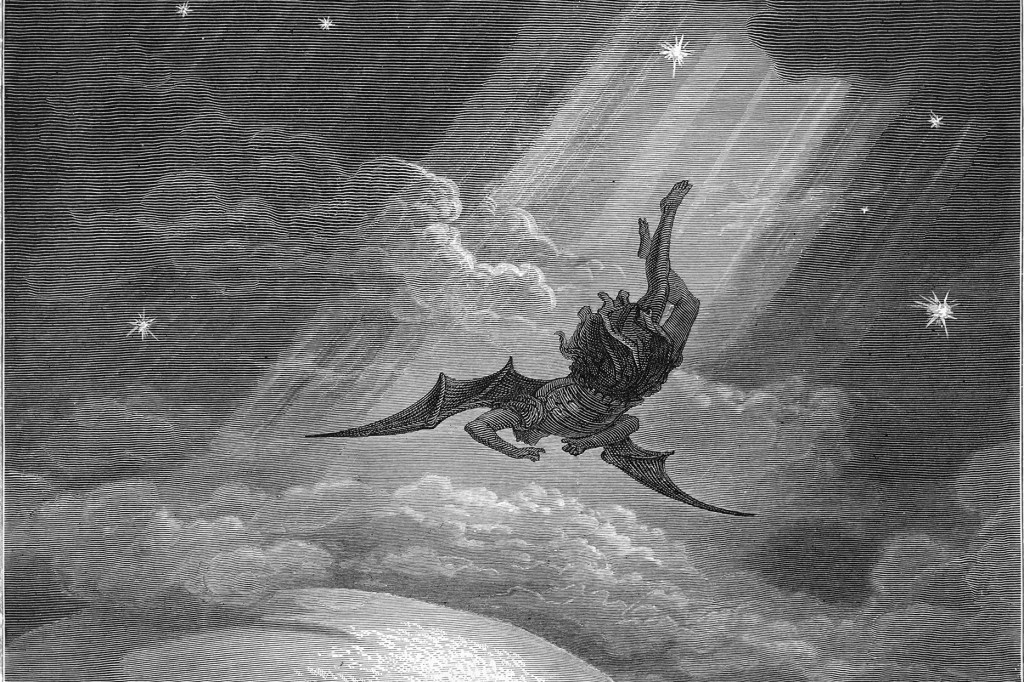
Meanwhile, John Milton’s epic poem Paradise Lost retells the story of the fall of man in such a way that portrays the Devil as an admirable yet tragic figure.
And of course, the subject of the Devil comes up a lot in music too. A famous urban legend has it that much of the radical progress in music can be traced back to a Faustian bargain involving the pioneering Blues musician, Robert Johnson.
As the story goes, Johnson wouldn’t have been able to revolutionize guitar-playing and songwriting in the ways that he did, if he hadn’t sold his soul to the Devil. The curse of this alleged transaction was that Johnson died young at 27 years old, and so would many revolutionary musicians after him, including Jimi Hendrix and Kurt Cobain.
Besides that, the invention of heavy metal music can be credited to the band Black Sabbath, who were the first to overtly don Satanic imagery and sound.
It can be said that heavy metal started with Black Sabbath’s first track of their debut album, both titled Black Sabbath, which makes use of what is known in music theory as the tritone, or “The Devil’s Interval”.
The tritone is a set of notes which produce an unsettling and sinister sound. Because of this, it was frowned upon especially during medieval times, and according to legend, it was feared that playing the tritone would summon the Devil himself.
Still, all of this are just the tip of the iceberg in explaining the Devil’s prominence in art and popular culture. With that, it is not completely ridiculous for some folks to believe that art and popular culture are simply part of the Devil’s conspiracy to take over the world. Or that every famous artist are secretly Devil-worshippers.
But what if there’s more to this than we see?

Well, the fact is that most of the Satanic acts that we see are a sham. Of course, there are few artists that genuinely worship the Devil. But that is really the exception rather than the norm.
Many artists that wear a Satanic outlook commonly do it for shock value. It is purely for entertainment purposes, not unlike how it is done in horror movies and plays.
Black Sabbath is no exception. In fact, during the band’s early days, they drew the interest of actual Satanic cults that took their music seriously. The band had to break it to them that it was all just a show. In response, one of those cults allegedly placed a curse on the band members.
As the band’s singer Ozzy Osbourne recounted, “I couldn’t believe it when I learned that people actually ‘practiced the occult.’ These freaks with white makeup and black robes would come up to us after our gigs and invite us to black masses at Highgate Cemetery in London. I’d say to them, ‘Look, mate, the only evil spirits I’m interested in are called whiskey, vodka and gin.’ At one point we were invited by a group of Satanists to play at Stonehenge. We told them to fuck off, so they said they’d put a curse on us.”
To protect themselves from the alleged curse, the band members started wearing crosses that Ozzy’s father made for them.
Another common motive that explains artists’ fascination with the Devil is in his being treated as a symbolic entity, rather than a literal one. The Devil as a symbol is frequently employed in art to drive a countercultural message of rebellion, or challenging the status quo. Considering its taboo nature, we often see this symbolism play out when artists are speaking up about sensitive or dogmatic matters, like religion and governance.
Tobias Forge, the leader behind the band Ghost, which is also well-known for their Satanic outlook, explains this well. “Pop-cultural Satanism is all about humanity,” he said. “It’s all about being able to express yourself and having the ability to. We’re humanists.”
Like many other similar acts, Tobias insists that Ghost’s Satanic imagery and songwriting are allegorical, as they are intended to address societal issues. As Tobias explains, “The biggest misconception (about Ghost) is that the lyrical content is being provocative because it’s about God. And it’s not. It’s not about God at all. It’s about mankind. I use language and analogy to make it seem that it is about other things, but the songs are about very real things.”
A great example of this is in how Ghost addresses the subject of religious trauma in their song Cirice. The lyrics are sung from the perspective of the Devil, who is comforting a person who is humiliated and abused by their religious community. “I know your soul is not tainted,” the lyrics say. “Even though you’ve been told so.” “Cirice” is an Old English word for “church”.
We can see this symbolic usage in literature as well, particularly in the works I’ve mentioned earlier. Mikhail Bulgakov uses the Devil as a vehicle in Master and Margarita to criticize the elite society of the Soviet Union for not daring to speak up against their government’s injustices.
In a similar vein, John Milton’s multidimensional portrayal of the Devil in Paradise Lost serves as a vehicle to explore themes such as the dangers of pride and ambition, as well as the complex nature of good and evil.
In summary, what I’m trying to get across in this article is: chill out. Before you jump the gun on accusing artists of being literally Satanic, do bother putting in the homework and understanding what those artists are saying in their work.
Personally, I think using the Devil in art is clever, if done well. Our society has a huge tendency to see the world strictly in terms of black and white, and good versus evil. We are so set in our own views, that we are unwilling to even listen to the differing opinions that others might have.
The Devil in art forces us to think differently, beyond our preconceptions. He forces us to see the world as it is, in its varying tints and shades of colors. He opens our minds to the world’s inherent duality, in that there are no absolutes. There is evil in good, and good in evil.
For example, as a Muslim, I’ve lived long enough to learn to adhere to my beliefs, while also being accommodating to those of other people. I’m also aware of the toxicities that exist within the Muslim society. I may practice my faith, but I may not agree with the society’s culture of shame and discrimination (especially towards non-Muslim and LGBT communities), when we’re essentially attempting to attract people to our religion.
I also had to learn that people, no matter how admirable they may seem, are simply human. In fact, two amazing religious speakers who I used to look up to and gave memorable talks in my high school were both later convicted of sexual harassment.
Ultimately, religion is one thing, and people are another. To quote Marilyn Manson in his song Disposable Teens, “I never really hated a one true God, but the God of the people I hated.”
This is one of the many grey areas in life that you are likely to overlook or ignore if you were too fixated on your worldviews.
So, the next time you encounter the Devil in art, remember that it’s just art, in most cases anyway. Digest it, learn from it, enjoy it. Don’t take it too literally.
 Izzat Zailan
Leave a Comment