
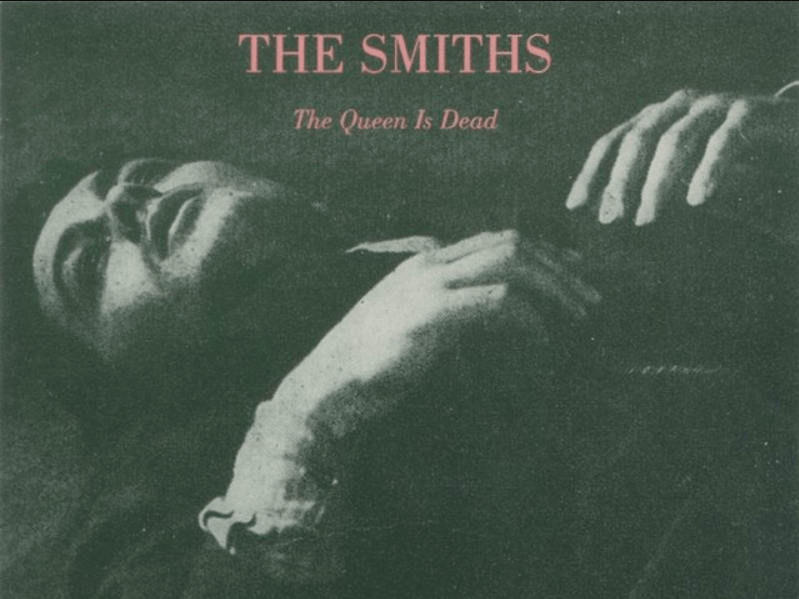
“Most music reminds people of when they first heard it, but the music of The Smiths — this is what we were.”
— Matt Miller
An Anthem for the Disillusioned
On one late summer evening in 1985, The Smiths singer Morrissey visited the home of guitarist and fellow songwriter, Johnny Marr, in Bowdon, Greater Manchester. It was, perhaps, one of the most productive nights of their creative partnership, as they ideated a few songs for what would become their defining album, The Queen is Dead.
Morrissey was perched on the edge of a coffee table, sitting directly across Marr, who was clutching his guitar. After exchanging ideas back and forth, Marr told him, “Well, I’ve got this one.”
Marr played a warm, cyclical progression of chords, which evoked a sensation of gentle forward motion, almost like the continuous steady movement of a serene night drive.
Morrissey was visibly shaken.
“It was as if he daren’t speak, in case the spell was broke,” Marr said of the incident. It was at that moment when Morrissey listened to the melodies of “There is a Light that Never Goes Out” for the first time.
In hindsight, Morrissey’s reaction feels so fitting, because few songs would come to capture the singular allure of The Queen is Dead, and by and large, The Smiths, quite so perfectly.
As the lyrics of the song later took form, it would depict a poignant portrait of a lonely, estranged young narrator, who experiences an existential yearning for human connection. The narrator goes on a night drive with a significant other, desperately wanting to leave their home for good, which they no longer perceive as their secure base.
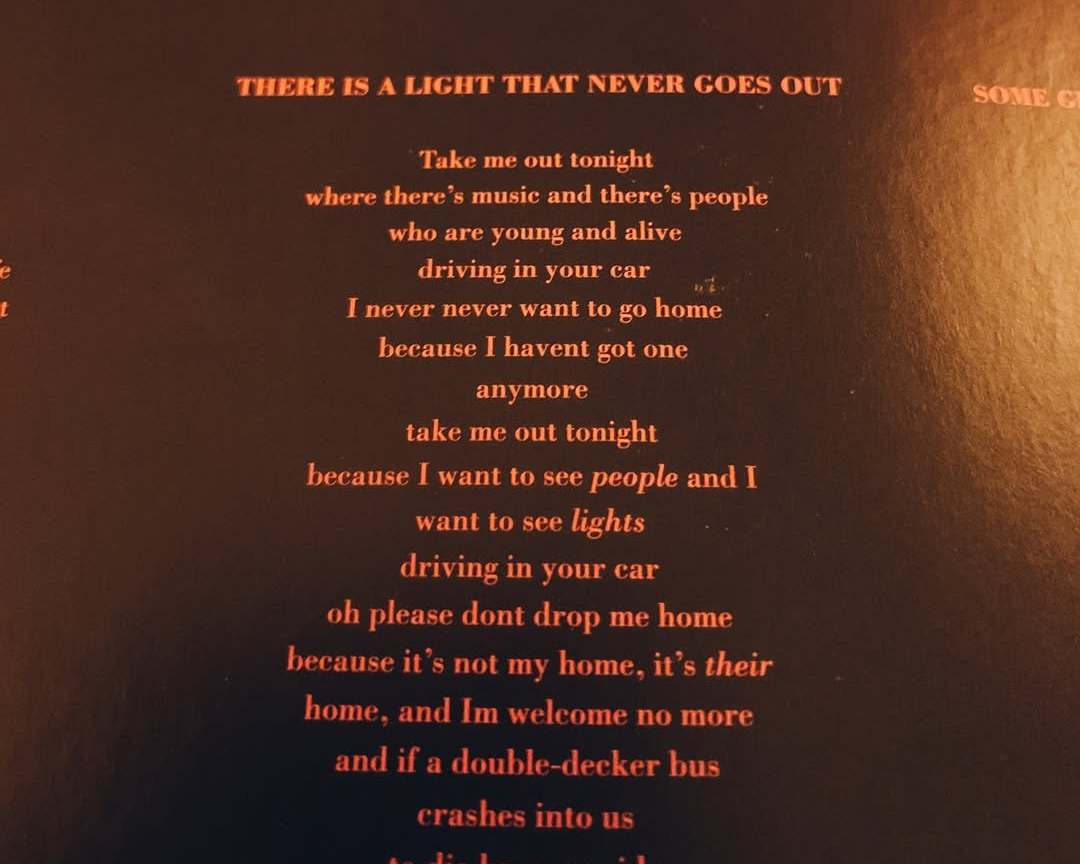
Listening to the song, one couldn’t help but notice how playfully deliberate the narrator’s choice of words are: “And if a double decker bus crashes into us, to die by your side is such a heavenly way to die. And if a ten-tonne truck kills the both of us, to die by your side, well, the pleasure, the privilege is mine.”
A double decker bus or a ten-tonne truck obviously isn’t a light vehicle, and just imagining being crushed by one should send shivers down your spine. But that’s exactly the hyperbole the narrator uses to express their inner turmoil.
They long for the love and acceptance they couldn’t find at home to such a soul-crushing extent, that even a gruesome death is worth the risk, so long as they get to be in the presence of someone who understands them.
Oddly, the song has become a sacred fan-favourite since its release, resonating across generations of listeners. It has become an enduring anthem, if you will, for the disillusioned.
“I didn’t realise that ‘There Is A Light That Never Goes Out’ was going to be an anthem,” said Johnny Marr. “But when we first played it I thought it was the best song I’d ever heard.”
Personally, I couldn’t get enough of the song. I’ve listened to it on repeat every day for months on end, even hunting down every live version, and every cover that I could find. I thought, and thought, and thought about the song as it accompanied me during commutes, during work, and during quiet idle nights. I was baffled myself as to why this bleak song has had such an appeal to me.
As it often runs through my mind when I listen to a great piece of music, I was compelled to understand what made it so. For starters, what exactly was Morrissey going through that drove him to pen The Smiths’ quintessential song? What was their creative process like? And what does the song even mean, at least to me, in the end?
I’m still not sure whether I’ve arrived at a satisfying answer to any of these questions. But this article is my best attempt to make sense of it all at this point in time.
The Context Behind “There is a Light that Never Goes Out”

To understand “There is a Light That Never Goes Out”, we first need to understand Morrissey.
Alienation has long been a recurring theme throughout Morrissey’s life. Even before The Smiths, he had a reputation within his local community as somewhat of a recluse. He was painfully shy, bookish, sexually ambiguous, and often seemed to find in music, particularly that of The New York Dolls, the only companionship he could count on.
But by the time The Smiths worked on The Queen is Dead, his sense of estrangement had deepened, almost to a breaking point. Morrissey was feeling increasingly alone in his own world, unable to relate to the people around him and to society at large.
At the most immediate level, his relationship with Johnny Marr, which had once been almost fraternal during the early days of The Smiths, was beginning to crack. As the pressures of the music industry bore down on them, Marr found Morrissey more and more difficult to work with, foreshadowing a feud that would fester for decades and remain unresolved to this day.
Beyond that, he felt estranged from the idea of home. Morrissey had always had a love-hate relationship with Manchester, where he was born and raised, and still living at the time.
“Manchester, so much to answer for,” as he sings in one of The Smiths’ earliest songs, “Suffer Little Children”.
Manchester had yet to answer for his troubled working class Irish-Mancunian upbringing, one that inherited the scars left by the Industrial Revolution, through which the city powered Britain’s economic rise on the backs of underfed and malnourished workers, many of whom were Irish immigrants.
Manchester had yet to answer for his brutal Catholic schooling, where his teachers often seemed more like bullies and tormentors than educators, as they enforced discipline through fear and humiliation.
Manchester had yet to answer for the slum clearance programmes that forced his family out of their home and tore apart rooted working-class communities in place of soulless estates like the Hulme Crescents. Far from their intended promise of progress, they became bywords for social breakdown, crime, and drug abuse.
Not least, Manchester had yet to answer for the Moors murders, a shocking series of child killings committed in and around the city between 1963 and 1965. The case hung over Morrissey’s youth like a dark cloud, and haunted Britain’s consciousness for decades, as several bodies were recovered from Saddleworth Moor, and one victim never found.
Now as an adult, he still struggled to find a proper sense of belonging in his home city that was so marred with trauma.
And on a broader social and political level, Morrissey felt out of step with Britain itself. He felt alone in his public contempt for the monarchy, which he believed provided no actual value to society. He felt that Britain was stuck in a cultural limbo, blindly clinging to royal tradition, less out of conviction than out of a deep-seated fear of change.
He was also a vocal critic of Margaret Thatcher, who was at the height of her power as Britain’s Prime Minister. Her reign was marked by mass unemployment, urban riots, and violent government clampdowns, as working class communities were battered by her policies of deindustrialisation, and treated as acceptable collateral in her march for economic reform. Manchester bore the brunt of this upheaval, only confirming for Morrissey that Britain had lost whatever moral compass it had once claimed to possess.
Steeped in loneliness in almost every sense, The Queen is Dead unsurprisingly returns again and again to the theme of isolation. At certain moments, Morrissey gives this disquiet a targeted focus. On the title track, for instance, he specifically indulges in his daydream of toppling the monarchy.
But in the penultimate track “There is a Light that Never Goes Out”, all of it converges. The romanticised night drive in the song is no mere car ride, but a transcendent escape — however temporary — from a lonesome inner world that has become too much to bear.
Still, context only takes us so far. To understand why the song works so well, we have to go beyond Morrissey’s frame of mind, and turn to The Smiths themselves, and the mechanics through which they transformed their influences into something uniquely their own.
How The Smiths Wrote “There is a Light that Never Goes Out”

I’ve always believed that a huge part of what makes “There is a Light that Never Goes Out” so great is that it’s a song that only The Smiths could have written.
It goes without saying that The Smiths are one of the most unapologetically unique bands I’ve discovered. Nobody quite writes lyrics in the same wit and dark humour as Morrissey, and nobody quite plays the guitar as intricately as Johnny Marr.
And definitely, you could never discount the contributions of bassist Andy Rourke and drummer Mike Joyce, who knew how to pitch in apt parts that worked just right for the songs, without drawing too much attention to themselves.
Collectively, they pioneered a distinctive sound characterised by a yin-and-yang of angsty, melancholic lyrical themes, and bright, melodic, and danceable instrumentation.
As John Reed, director of catalogue at Cherry Red Records rightly put it, The Smiths “became a template — something either sounds like The Smiths or it doesn’t.”
Yet, originality is quite the paradox. Even a band as daringly unique as The Smiths didn’t create music in a vacuum, as they cleverly borrowed various elements from other musicians, and even from other art forms.
But it’s important to understand that what made The Smiths, The Smiths, wasn’t merely in their act of borrowing, but in internalising and intently applying their various influences in ways that personally made sense and felt most natural to them.
Morrissey was never coy about the fact that his songwriting was highly influenced by the “kitchen sink” plays, novels, dramas and TV shows from the late 1950s to the early 1960s, which realistically portrayed the everyday domestic lives of the British working class.
Reflecting on his own creative development, he admitted in a 2006 interview with Mojo magazine that he had relied heavily on other artists’ ideas in his earlier years, even saying that he had “overdid it with (kitchen sink playwright) Shelagh Delaney”.
But he also arrived at the more important conclusion, that “no one is ever quite as original as they think they are”, and what matters in the end is whether “the great mesh” of one’s influences becomes something “unique enough”.
Circling back to “There is a Light that Never Goes Out”, it’s always interesting to notice its traces of inspiration.
For instance, the song shares several overlaps with “Lonely Planet Boy”, a folksy tune by Morrissey’s beloved New York Dolls. Both songs are framed around a car ride with a significant other, perceiving human connection (or the idea of it) as a way out of existential loneliness. And in both songs, the narrator laments how they no longer have a place to call home.
And quite clearly, the opening lines of “There is a Light that Never Goes Out” — “Take me out tonight, where there’s music and there’s people, and they’re young and alive.” — were lifted from a dialogue snippet from the 1960 kitchen sink drama Saturday Night and Sunday Morning, in which the character Doreen utters to the protagonist Arthur, “Why don’t you take me where it’s lively and there’s plenty of people?”
Instrumentally, the song’s opening F♯m-A-B chord sequence was borrowed from the Rolling Stones’ cover of Marvin Gaye’s “Hitch Hike”. Marr later said he did this deliberately, partly to see whether the press would mistakenly trace it to the Velvet Underground’s “There She Goes Again”, which he believed had itself taken the idea from Gaye’s song. “I knew I was smarter than that,” he remarked. “I was listening to what the Velvet Underground was listening to.”
To use an analogy, The Smiths’ creative process was very much like reading a book. We absorb new vocabulary, ideas and ways of seeing the world, then make sense of them by filtering them through our own life.
Over time, they become so ingrained in us that we draw on them, consciously or subconsciously, to express our own thoughts in a way that’s shaped by our own temperament and experience. And if we do this well enough, the borrowing disappears into something that feels wholly personal.
In the end, “There is a Light that Never Goes Out” sounds little like any of its influences in isolation. And that was The Smiths’ gift — they were able to take borrowed fragments of inspiration and transform them into something unmistakably their own, bound together by a distinctly British sensibility which suggested even the gloomiest of circumstances could still leave room for the light to glimmer through.
Making Sense of the Song
A version of “There is a Light that Never Goes Out” that I find myself returning to often is a particular live performance by Morrissey, at a homecoming concert in Manchester in 2004.
I’m continually filled with awe by the sea of 50,000 people singing their heart out to every word, and jumping about in excitement to the rhythm. Somehow, despite the gloomy lyrics, the song transformed into something exceptionally uplifting that night. I’d like to imagine that in those four brief minutes, every single person in the audience was singing about a time in their lives when the song meant the whole world to them.
Though, there’s kind of an irony here. I couldn’t speak for anybody else, but I objectively don’t see “There is a Light that Never Goes Out” as a romantic song at all. In fact, I find it tragic as hell.
Much of what the narrator utters in the song comes across as unhealthy, as they overly idealise human connection as the end-all-be-all solution to their problems. They seem to live in such a small world, that just being in the presence of someone they haven’t even communicated their feelings for is enough to make them feel vividly alive.
I also get a very dreamy vibe from the song. The instrumentation, particularly the jangly shimmering guitars and the eerie synthesised strings — as well as the fact that very little happens plot-wise — gives me the impression that the narrative might not actually be taking place, but exists only as a fantasy. (Which is why this song hurts even more.)
The car ride is the narrator’s idealised sanctuary — a suspended moving world where they are purely free from expectations, free from any sense of rejection, and are free to exist authentically while still retaining a sense of belonging.
But we all know that in reality, such a sanctuary doesn’t exist. As beautiful and meaningful as relationships can be, people are inherently imperfect.
The tragedy of the song is that the narrator probably isn’t in the right emotional state to realise or remember that when you look for fulfillment outside of yourself, it will only leave you feeling even emptier and lonelier.
“There is a light and it never goes out…There is a light and it never goes out…,” the narrator tells themselves over and over again at the song’s close, like an affirmation repeated in the hope that saying it often enough would make it feel true.
But perhaps, what still makes the song endearing is that, we’ve all been there, albeit to different extents.
Perhaps, we keep returning to “There is a Light that Never Goes Out” because it articulates our private feelings that are often humiliating in ordinary life: loneliness, wanting to leave home, feeling misunderstood, and desperately wishing for one person to make our lives feel less empty.
Most songwriters either underplay these feelings, but Morrissey voiced them out, honest and unashamed. As indie musician Joe Pernice reflected, “Morrissey sang like he was as miserable, terrified and as poorly designed as the rest of us. He captured it perfectly.”
As we close this article, I believe this reasserts why “There is a Light that Never Goes Out” has endured so strongly across generations, and why it stands out as The Smiths’ quintessential song.
The song captures The Smiths at their absolute peak, while painstakingly containing so much of what life can feel like in a given moment: sublime yet lonely, tender yet tragic, wounded yet transcendent.
All of it, in a sonic space that hovers between reality and dream.
 Izzat Zailan
Leave a Comment