
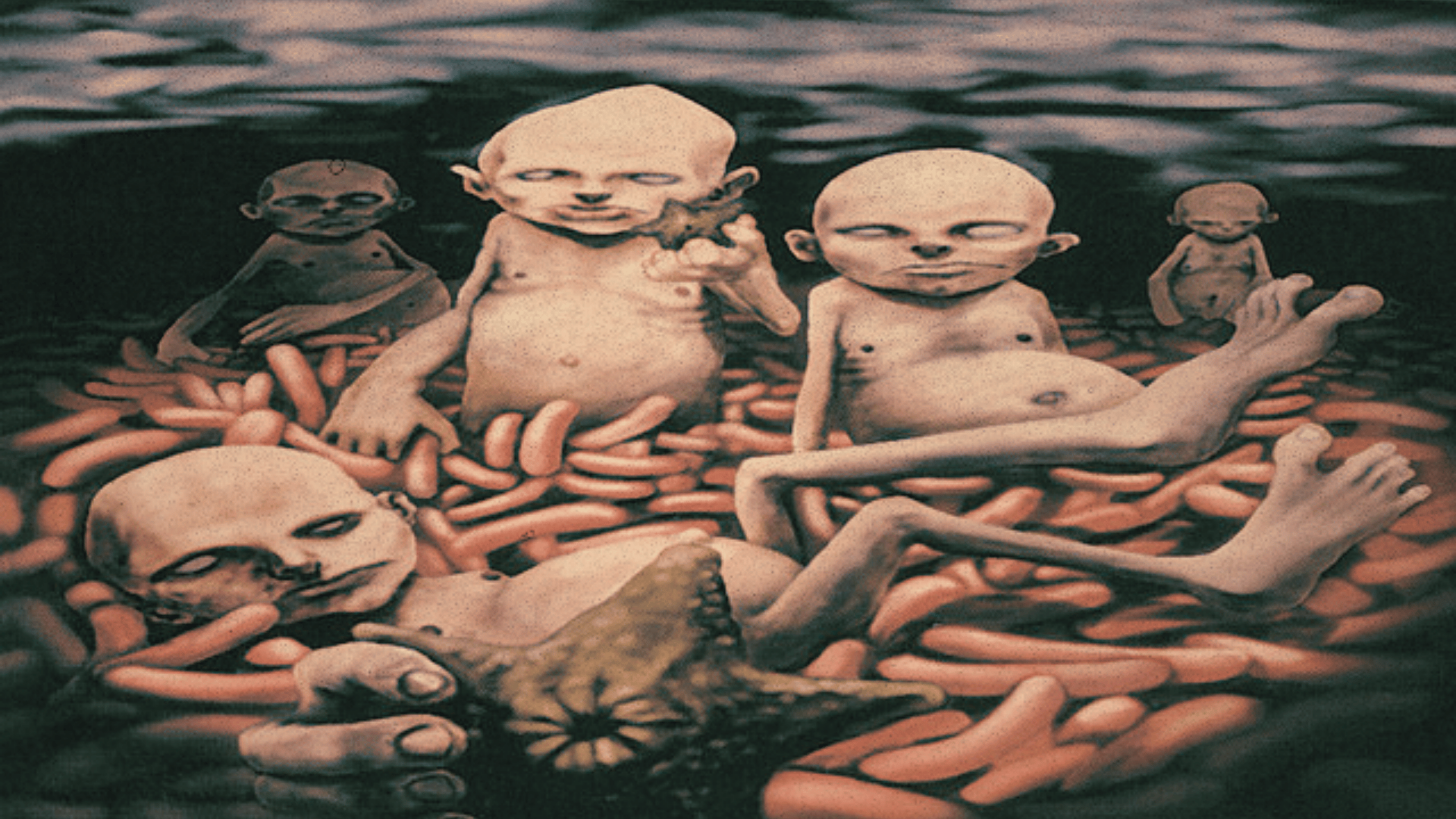
“At long last he was unencumbered, emancipated from the stifling world of his parents and peers…”
— Jon Krakauer,
Into the Wild
I’m quite a sentimental crank nowadays. I often find myself thinking about my childhood, particularly the music that bookmarked my upbringing.
It probably had something to do with a Papa Roach show I attended a couple of months back. During their encore, they played a short medley of nu metal songs that were popular when I was a little boy in the early 2000s. One of the bands they paid tribute to was Limp Bizkit.
Standing there in the front row, listening to their thirty-second cover of “Break Stuff” filled me with a gnawing sense of introspection, just as the forty-something-year-olds around me were absolutely losing their shit.
Limp Bizkit had always been in the background of my childhood. I heard their singles on the radio during car rides. Whenever “Rollin’ (Air Raid Vehicle)” played, my siblings and I had our thing where we’d chant our sister’s name in the chorus. (We still do, as a matter of fact.) I also remember seeing their music videos on MTV, and even having a few songs saved on my PsP, which I mainly used as an MP3 player.
Yet my appreciation for them was merely surface-level, as I never felt an honest connection to them. Even as I grew a little older, I thought their music was overly macho and mindlessly aggressive.
In my defense, their biggest hit is literally titled “Break Stuff”. Throw into the mix Fred Durst’s many public feuds, as well as the way the band became one of the easiest scapegoats for the Woodstock ’99 disaster, and it became convenient for me to dismiss them almost entirely.
But after that night at the Papa Roach show, I felt the need to reassess whether my perception of Limp Bizkit still held true.
Among all their tracks that I relistened to, “My Way” hit me the hardest.
With its theme of rebellion and angst, it’s easy to perceive the song as one-dimensional, just as I had all these years.
But after multiple back-to-back intentional listens (and perhaps growing older), I came to appreciate how emotionally sophisticated the song really is.
If I were to put myself in the same frame of mind as before, I would only notice how angry it sounds. The narrator seems to embody such a livid sense of discontent with the status quo, vehemently affirming his own way of moving through the world. “My way or the highway,” he insists. It’s all or nothing in his lonesome crusade.
But listening to it now, I couldn’t help but also notice a bitter pang of fear in his words and in the overall gestalt of the song.
The narrator may be rebelling, yes. But something tells me he isn’t entirely sure that his way is right either.
I tend to imagine the song as an entire world unto itself. As listeners, we are not merely hearing the narrator’s thoughts from a distance. Rather, we are being placed inside his head.
The simplicity of the song leaves much to the imagination. From my perspective, I envision the narrator as someone akin to Christopher McCandless in Into the Wild — a person determined to prove that he can make it on his own, without anybody’s help.
Like McCandless, there is a romance to his escape. There is something very seductive about the idea of walking away from everyone who misunderstood you, doubted you, mocked you, or tried to define you.
But there is also something fragile about it.
The song begins with, and repeatedly returns to, the refrain “check out my melody,” sampled from hip-hop duo Eric B. and Rakim’s track “My Melody”. In the original track, the phrase carries a sense of swagger. Rakim presents himself as an artist bending rap away from predictable patterns and toward something smoother, freer, and more rhythmically inventive.
In the context of Limp Bizkit’s “My Way”, however, the refrain takes on a different meaning. It becomes the narrator’s declaration of his worldview. It is the sound of someone announcing — perhaps almost pleading — that he has found a private path worth standing by.
Yet the refrain is set against a moody, grainy guitar riff, which makes it sound suspended in the atmosphere. The riff itself feels lonely, spacious, and vaguely ominous, as if attention is turned inward rather than outward, into a headspace where thought hasn’t yet fully settled into language.
And when the verse arrives, it seems as though the narrator’s thoughts are only beginning to organise themselves into argument. “You think you’re special. You do,” he says. “I can see it in your eyes. I can see it when you laugh at me, look down on me, and walk around on me.”
It’s interesting to note how the song is directed at a “you”, instead of society in the abstract. The “you” could be a parent, a boss, a teacher, the list goes on. The narrator isn’t defying a faceless system, but someone whose approval they likely once valued to some extent.
“Someday, you’ll see things my way,” the narrator tells them.
And here’s the great irony of the song. The narrator desperately wants freedom, but also yearns for vindication. He wants to turn his back on the world, but secretly hopes the world turns around to watch him leave. He wants to believe that he doesn’t need anyone’s approval, but still imagines the day when the people who doubted him will finally realise he was right.
Another thing about the song that I find intriguing is its deliberate repetitiveness. It is as if much of what we hear is the narrator’s own mental rehearsal: repeating lines to will himself into confidence, practicing arguments with the person, or people, he is rebelling against, and working up the nerve to finally break away from their fold.
There is one part of the song that especially encapsulates this.
Just after the bridge, we reach a somewhat tranquil moment where it is just the narrator and the guitar. Following all that mental noise, the song suddenly pauses, like a calm before the storm, or a final breath before the big leap.
The hi-hat then snaps and counts us in, and we arrive at the final chorus — the moment where the narrator finally says, with every fiber of his being, what he had been rehearsing all along. He emotionally severs himself from the people he once belonged to, turns his back on them, and walks fully into his own way.
But what happens to the narrator after that, at the very end of the song?
Obviously, we just don’t have a solid answer. But I doubt it is a happy ending.
After all the aggression has burned itself out, the once-loud guitars return quiet and tired, and the once-defiant refrain “check out my melody” slowly decays into the distance — a dying echo swallowed by a sublime expanse of nothingness and indifference.
The world keeps turning, and life simply goes on without him.
All in all, this is what makes “My Way” much more haunting than I ever gave it credit for.
On a personal level, I think the reason it hits so hard is because it reminds me that a lot of what we think and say in times of anger or hurt aren’t always true — or at least, we only mean them in that moment.
Sometimes, what might entice us as freedom is really just a reaction. And often, when someone says they no longer care, it’s because they care more than they can admit.
As he died alone in the unforgiving Alaskan wilderness, Christopher McCandless scribbled in his journal a thought that arrived too late. He wrote, “happiness only real when shared.”